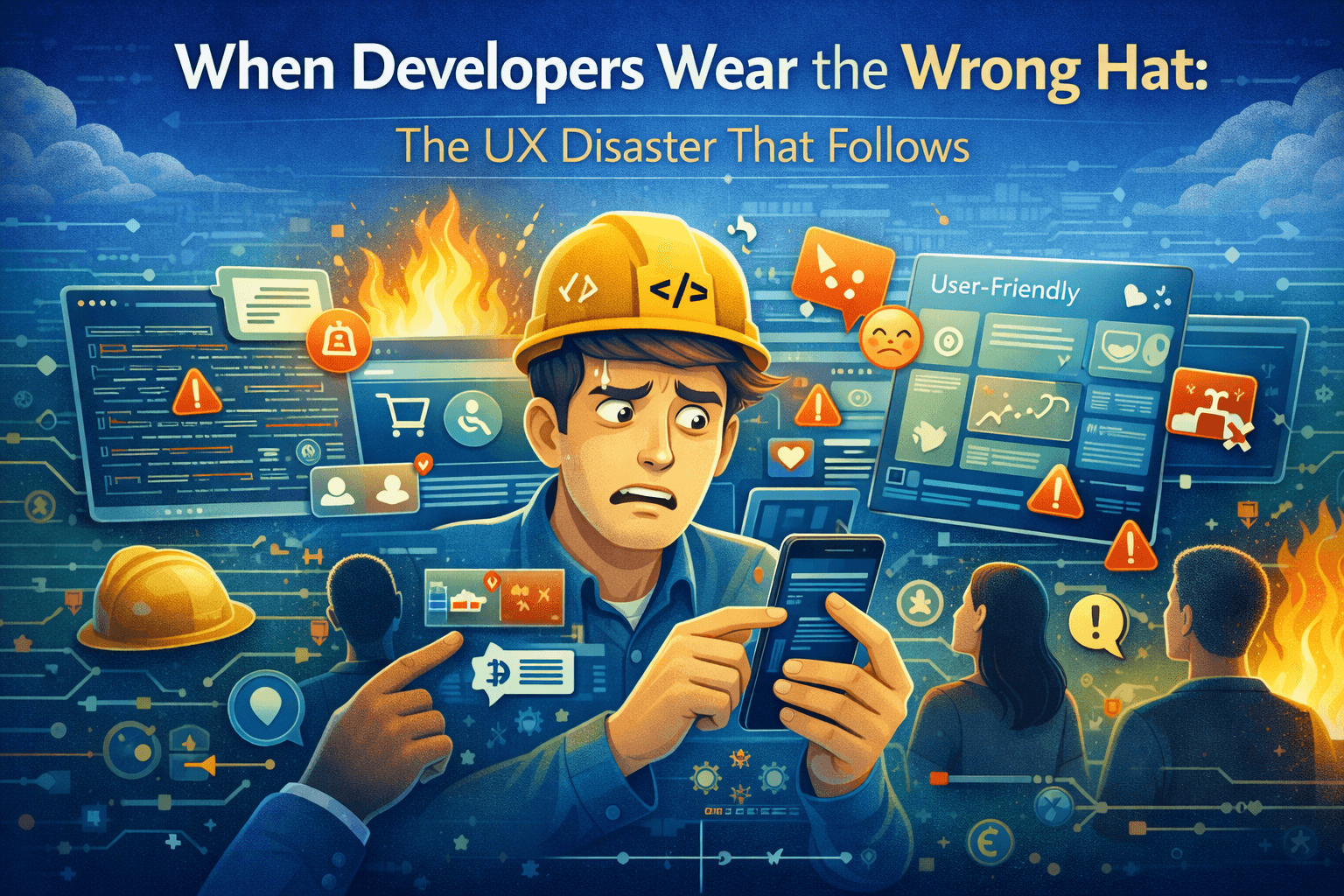
When Developers Wear the Wrong Hat: The UX Disaster That Follows.
In many digital teams, the lines between UX, UI, and development have blurred. By Chemsseddine SALEM | UX Research & Product Design | 2025
The Line Between Building and Designing
In many digital teams, the lines between UX, UI, and development have blurred sometimes productively, sometimes catastrophically.
The modern front-end developer is often seen as a “UX-minded builder,” someone who understands both code and user interface. But in some organizations, that overlap turns into confusion, even overconfidence.
Suddenly, a developer begins to “sell” UX strategies to the business, pushing their interpretation of user experience as if it were grounded in research and behavioral science. The result? Design-by-imitation instead of design-by-insight.
And when those assumptions fail in production, when users get lost, conversion drops, or workflows become fragmented, it’s no longer a matter of code. It’s a UX disaster in disguise.
1. The Rise of the “Pseudo-UX Developer”
In today’s lean, fast-moving tech culture, many developers step into UX territory. Sometimes out of curiosity. Sometimes because there is no dedicated UX team. Sometimes because businesses think “UX” means “make it look good and work fast.”
But the problem begins when familiarity replaces expertise.
Using a design system, following a few design heuristics, or copying a successful pattern from another product doesn’t make someone a UX designer, just as sketching a wireframe doesn’t make someone a front-end engineer.
UX is not about how things look. It’s about why people behave the way they do. It’s psychology, behavior, context, and data-driven empathy.
When developers skip those steps, assuming UX is “intuitive enough”, they unintentionally sabotage both user and business outcomes.
2. When “UX Advice” Becomes a Liability
Developers are problem-solvers by nature. They like efficiency, logic, and order. But UX is not linear it’s messy, emotional, and deeply human.
When a developer begins “advising” the business on UX direction without real user research, several things happen:
Assumptions replace insights.
Decisions are made based on personal logic, not user evidence.Design systems become cages.
Components are used rigidly, not contextually “because it’s in the system” rather than “because it solves a user pain point.”User testing is skipped or simulated.
“I asked my colleague” replaces structured usability testing.The narrative shifts from empathy to efficiency.
“This is faster to build” outweighs “This is easier to use.”
Over time, these shortcuts stack up like bad code invisible at first, but eventually creating friction, confusion, and rework costs.
3. The Business Fallout: When UX Debt Hits the Bottom Line
UX debt is like technical debt except it’s paid in user frustration.
When a pseudo-UX approach dominates, these outcomes are common:
Rising support tickets because users can’t complete core tasks.
Lower adoption rates despite technically solid releases.
Confused business stakeholders wondering why “the design system didn’t work.”
Erosion of trust between teams developers blaming “unclear requirements,” UX designers blaming “implementation shortcuts,” and business teams losing confidence in both.
Eventually, the organization pays in rework, reputation, and retention not just code rewrites.
4. The Psychology Behind the Confusion
The overlap between roles isn’t accidental.
Developers are naturally proud of their ability to make things real. Designers, on the other hand, imagine how those things should feel. The bridge between the two is empathy, communication, and respect for expertise.
When a front-end developer begins to dictate UX strategy, it often stems from good intentions the desire to improve. But without grounding in cognitive psychology, usability principles, or ethnographic research, those improvements risk being superficial.
It’s like diagnosing a patient after watching a medical tutorial you might recognize the symptoms, but not the underlying cause.
5. The “Design System Trap”
One of the most common justifications developers use when stepping into UX territory is the existence of a design system.
“I’m following the components; that’s good UX, right?”
Not necessarily.
A design system is a tool, not a replacement for thinking.
Just because a component looks clean doesn’t mean it solves the user’s problem. The system provides consistency, but only UX research provides relevance.
True UX work asks:
Does this interaction reduce cognitive load?
Does this flow match user mental models?
Does this message clarify or confuse?
Without these questions, the system becomes a mask beautiful but blind.
6. Why UX Belongs to UX Experts
Imagine a UX designer walking into a developer meeting and declaring how the code should be structured.
“Use this function, it’ll perform better.”
The developers would push back and rightly so.
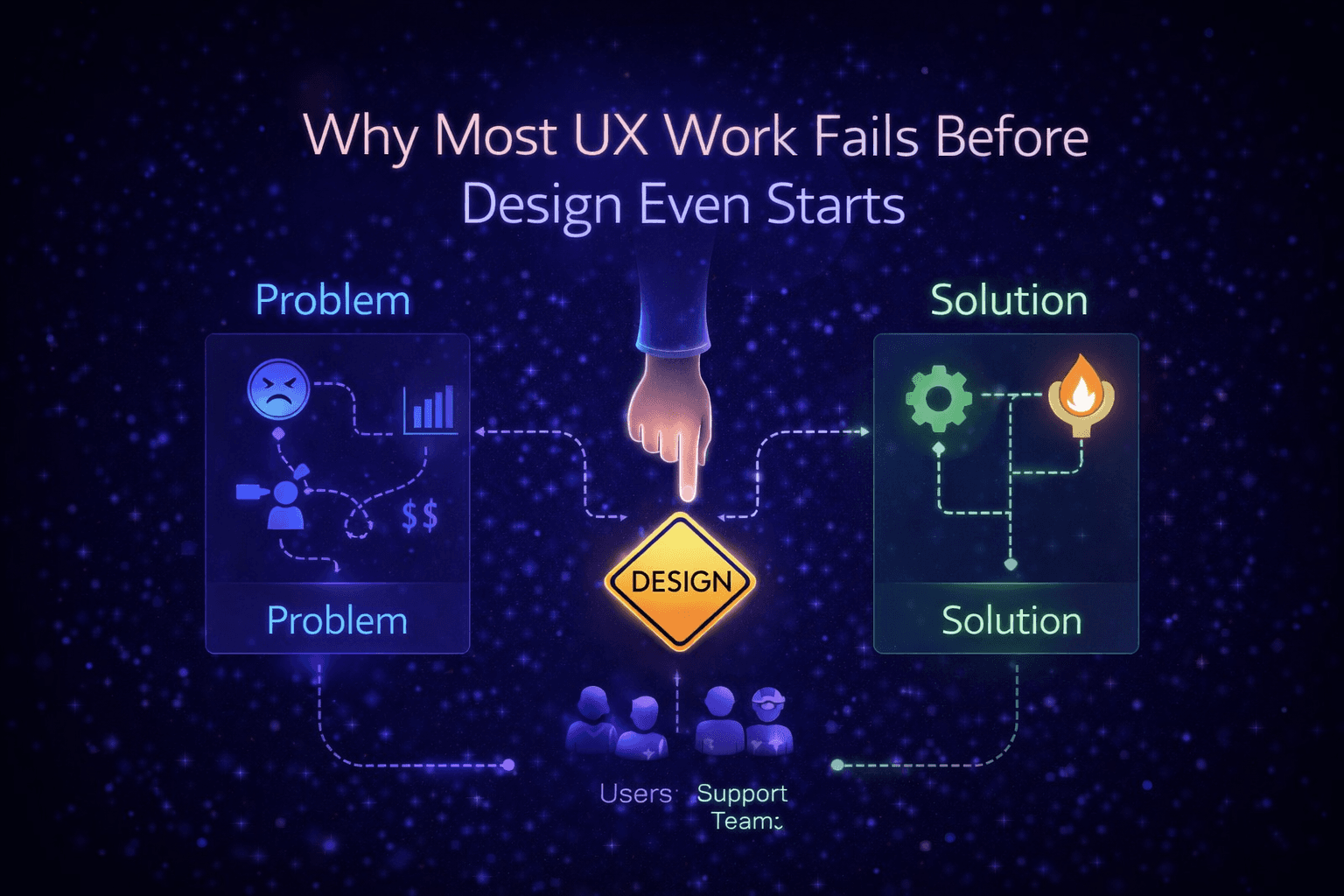
That’s exactly what happens when a developer presents UX strategy to the business without the proper foundation. It’s not just role overreach; it’s risk.
UX research involves interviewing users, interpreting qualitative data, running controlled tests, and synthesizing behavioral evidence. It’s about finding truth, not just patterns.
Without that grounding, “developer-driven UX” quickly devolves into assumption-driven design and eventually, user alienation.
7. Collaboration, Not Substitution
The solution isn’t isolation. It’s collaboration.
UX and front-end should work as partners one exploring why, the other enabling how.
UX researchers uncover user motivations and pain points.
UX designers translate those insights into interaction logic.
Developers bring that logic to life within real-world constraints.
When that balance is respected, innovation flows.
When it’s ignored, misalignment multiplies.
A healthy product culture doesn’t blur boundaries to save costs it honors expertise to maximize value.
8. Rebuilding Trust Between UX and Development
If your team already suffers from this overlap problem, it’s not too late. Start with three critical steps:
Re-educate the business on what UX truly means.
Create awareness sessions or workshops to demystify research, usability, and emotional design.Establish a UX governance framework.
Define clear ownership for decisions involving user research, testing, and interaction strategy.Encourage cross-functional empathy.
Let developers observe usability sessions. Let designers join code review standups.
Understanding each other’s craft builds mutual respect not competition.
9. The Ethical Side: Responsibility Toward Users
When developers act as UX experts without proper grounding, the harm is not just organizational it’s ethical.
Users pay the price for poorly informed decisions.
Designers and researchers exist to advocate for users. Developers exist to make that advocacy tangible.
When either group oversteps without understanding, the user loses their voice in the process.
And in today’s world where user trust and retention are fragile that’s the cost no company can afford.
10. Closing Thoughts: Wearing the Right Hat
In the end, UX design and front-end development share the same goal: to build experiences that matter.
But excellence depends on clarity of roles.
A developer who copies UX patterns without user research is like a chef following a recipe without tasting the dish might look right, but something vital will be missing.
Respecting UX expertise doesn’t limit creativity it strengthens it.
Because when everyone wears the right hat, the product and the user always win.
By Chemsseddine SALEM | Lead UX Designer & Researcher | Enterprise SaaS & UX Strategy | UX Governance | Finance & Energy Sectors | 2025