Why Most UX Work Fails Before Design Even Starts
Behind every great user experience is a powerful toolkit. Discover five essential UX tools that transform collaboration, testing, and design impact.
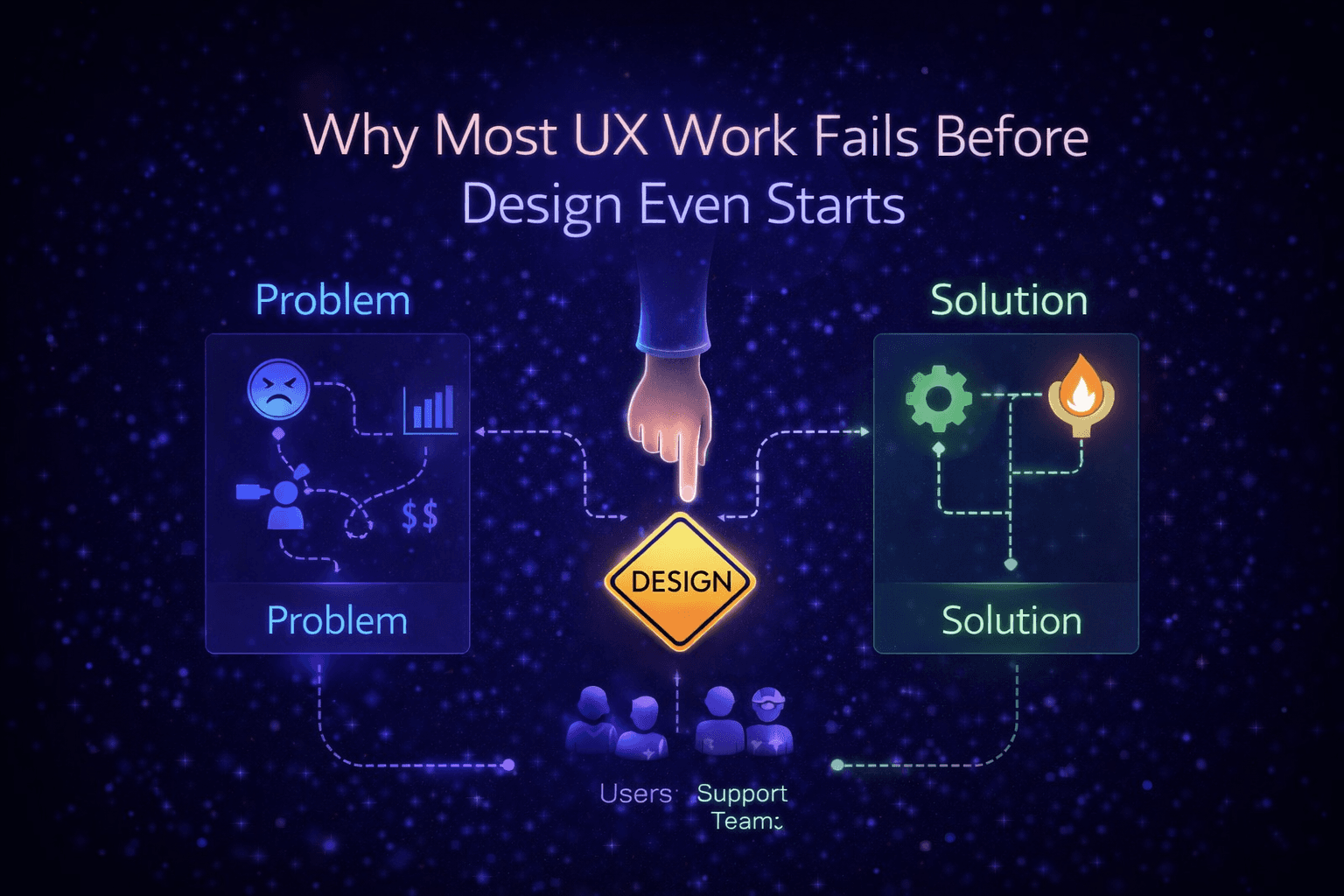
Why Most UX Work Fails Before Design Even Starts
In large organizations, UX failure rarely originates in screens, flows, or interaction details. By the time a design problem is visible, the conditions that determine success or failure are already locked in. Most UX work does not fail because designers lack skill, research, or intent. It fails because the system in which UX operates has already decided the outcome.
This is especially true in enterprise SaaS platforms, financial institutions, energy infrastructure, and government environments, where decision making is shaped by regulation, risk exposure, legacy processes, and political accountability. In these contexts, UX is often asked to improve outcomes that the organization has structurally made impossible.
The failure happens before design begins.
The Invisible Phase That Shapes Everything
Before a single wireframe is produced, a series of upstream decisions quietly define the limits of what UX can achieve.
Strategic priorities are set without user impact representation. Business cases are approved based on delivery speed or compliance rather than usability or operational clarity. Success metrics are defined around output instead of outcome. Ownership is fragmented across product, technology, compliance, legal, and operations.
By the time UX is engaged, the problem is no longer open. The scope is fixed. The timeline is compressed. The risk posture is non negotiable. The solution space has already collapsed.
Design teams are then asked to optimize within constraints they did not create and cannot influence.
From the outside, it looks like a UX execution issue. Internally, it is a system design failure.
Why Research Does Not Save the Situation
Many organizations believe research is the safeguard. If insights are strong enough, decisions will change. In practice, this assumption rarely holds in regulated or enterprise environments.
Research often enters the process after strategic intent has been established. At that point, insights are filtered through political feasibility, regulatory interpretation, budget constraints, and delivery commitments. Findings that support the existing direction are amplified. Findings that challenge it are labeled as unrealistic, out of scope, or future considerations.
This creates a false sense of rigor. Research exists. Workshops are held. Personas are documented. Yet decisions remain unchanged.
The issue is not the quality of research. It is the absence of decision authority tied to insight.
When UX research does not have a defined role in shaping strategic choices, it becomes a validation tool rather than a decision instrument.
Accountability Without Authority
One of the most consistent failure patterns in enterprise UX is accountability mismatch.
UX teams are held responsible for adoption, efficiency, error reduction, and satisfaction. Yet they lack authority over policy constraints, data availability, process sequencing, and system integration. In banking and energy platforms, these factors matter more than interface quality.
For example, a user flow may be clear and usable in isolation, but if approval logic is driven by regulatory interpretation or if data latency is dictated by upstream systems, the experience will still feel broken to the user.
UX absorbs the blame for outcomes it cannot control.
This mismatch creates defensive design behavior. Teams focus on surface level improvements because deeper structural issues are politically or organizationally untouchable. Over time, UX becomes synonymous with polish rather than leverage.
Governance Is the Real Design Surface
In complex organizations, governance is the true design surface.
How decisions are escalated. Who has veto power. How risk is interpreted. How compliance is operationalized. How incentives are aligned. These mechanisms shape the user experience more profoundly than any interaction pattern.
Design systems offer a clear example. Many fail not because components are poorly designed, but because ownership is unclear, contribution models are politicized, and adoption is optional. The organization treats governance as an afterthought and expects design consistency as a result.
The same pattern appears in research operations, accessibility initiatives, and platform modernization efforts.
Without governance design, UX remains tactical.
UX Debt Begins Long Before Interfaces Exist
Organizations understand technical debt. They rarely recognize UX debt.
UX debt accumulates when early decisions prioritize speed, internal convenience, or compliance shortcuts over clarity and usability. These decisions hard code complexity into processes and data models. Design teams later attempt to compensate through interface work, training, or documentation.
This is common in financial and governmental platforms where legacy workflows are preserved to minimize regulatory risk. The result is a growing gap between how the system works and how users understand it.
UX debt is dangerous because it compounds silently. Each new feature inherits the same structural complexity. Over time, even excellent design teams struggle to make meaningful improvements.
Why Maturity Models Mislead Leaders
Many executives rely on UX maturity models to assess progress. These models suggest a linear evolution from basic usability to strategic influence.
In reality, maturity is not linear. It is contextual and systemic.
An organization may have advanced research capabilities but no influence on strategic decisions. It may have a design system but fragmented governance. It may invest heavily in UX talent while keeping decision authority centralized elsewhere.
Maturity models obscure these contradictions. They create a comforting narrative of progress while avoiding the harder question of structural alignment.
Leaders then invest in tools, roles, and processes without addressing the root constraints that limit impact.
What Actually Needs to Change
If most UX failure happens before design begins, then improving UX outcomes requires intervention upstream.
This means redefining when UX enters the decision process. It means clarifying how insight informs strategy. It means aligning accountability with authority. It means treating governance, incentives, and decision rights as design problems.
For executives, this is not a UX issue. It is an organizational effectiveness issue.
For UX leaders, the challenge is not to produce better artifacts, but to make the invisible visible. To name the constraints that shape outcomes. To shift conversations from interface quality to decision quality.
A Final Reality Check
When UX is consistently asked to fix problems it did not create, frustration is inevitable. Teams burn out. Leaders lose confidence. Users disengage.
The solution is not more design effort. It is earlier, sharper, and more honest engagement with how organizations actually make decisions.
Until that happens, most UX work will continue to fail before design even starts.
And no amount of interface excellence will change that.
—Written by Chemss Salem